

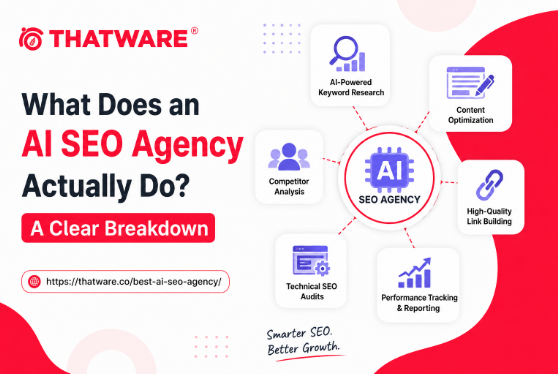
The phrase “AI SEO agency” has been repeated so many times in marketing materials that it’s almost lost meaning. If you ask ten agencies what they mean when they say they use AI for SEO, you’ll get ten different answers — and some of them won’t hold up well under follow-up questions.
So let’s actually break down what a serious AI SEO agency does. Not what they say they do in pitch decks, but the actual work — the day-to-day and week-to-week activities that, when done well, produce meaningfully better organic performance than conventional approaches.
The Diagnostic Layer: Where It All Starts
The work that distinguishes an AI SEO agency from a traditional one tends to start at the diagnostic phase. Conventional SEO audits look at technical issues, keyword rankings, backlink profiles, and on-page optimization factors. Useful, but limited.
An AI-driven diagnostic goes deeper. It uses machine learning to analyze the probabilistic relationship between a domain’s current signal architecture and the query space it’s trying to compete in. That means processing not just what keywords a site ranks for, but what entity relationships Google has established around the domain, what behavioral signals are telling the algorithm about content quality and user satisfaction, where crawl budget is being consumed inefficiently, and how the site’s semantic authority compares to competitive benchmarks in ways that keyword gap analysis alone can’t capture.
In practice, this diagnostic work typically takes two to four weeks for a mid-sized domain and longer for large enterprise sites. The output isn’t a list of broken links and missing meta descriptions — it’s a model of how Google currently perceives the domain and where the highest-probability opportunities for improvement lie.
Content Strategy: From Keywords to Entity Architecture
Once the diagnostic is done, content strategy in an AI SEO context looks quite different from a traditional keyword research and content calendar exercise.
Instead of mapping keywords to pages, the work maps entity clusters to content architecture. The question isn’t “what keywords do we need to rank for” — it’s “what entity relationships does this domain need to establish or strengthen in order to increase its probabilistic authority in these query spaces.”
That framing produces different recommendations. You might end up building fewer pieces of content, but with more semantic depth and clearer entity positioning. You might restructure existing content around entity relationships rather than adding new pages. You might prioritize certain internal linking changes over new content creation because the entity authority already exists but isn’t flowing to the right places in the site architecture.
The AI component does the heavy lifting on the analysis — identifying entity gaps, modeling competitive entity authority, predicting which content investments have the highest probability of producing ranking improvements given the current state of the domain. The humans do the interpretation and the creative work of turning those signals into actual content.
Technical Implementation: The Unglamorous Core
A lot of what an AI SEO agency actually does is technical work that doesn’t make for exciting case studies but has significant impact. Crawl budget optimization. Structured data implementation. Page experience signals. Site architecture adjustments to improve entity signal flow.
The AI component helps here in the form of automated monitoring and anomaly detection. Large sites generate enormous amounts of crawl and index data, and detecting meaningful changes — a new crawl efficiency problem, an indexing issue on a specific template type, a shift in how structured data is being parsed — requires processing more data than a human analyst team can reasonably handle manually. Machine learning systems that flag anomalies for human review allow the team to catch and respond to issues much faster than conventional monitoring setups.
Link Acquisition and Authority Building
This is the area where AI SEO agencies vary the most in their approach. At the sophisticated end, link acquisition is guided by entity relevance modeling — identifying the linking sources that would most strengthen the domain’s entity authority in specific query spaces, rather than just pursuing sites with high domain authority scores.
At the less sophisticated end, it’s basically the same link building that’s been done for fifteen years, with “AI” added to the prospecting or outreach automation. That’s not meaningless — efficiency gains are real — but it’s not a fundamentally different approach.
Ask specifically how an agency thinks about link acquisition in the context of entity authority. The answer will tell you a lot about how deeply they’ve actually integrated AI into their methodology.
Reporting and Measurement
AI SEO services at the better agencies include measurement frameworks that go beyond rankings and traffic. Leading indicators that matter in an AI-driven approach include entity coverage velocity, behavioral signal improvements (dwell time trends, pogo-sticking rates, return visit rates), structured data coverage, and crawl efficiency metrics.
These take more effort to build dashboards for and more sophistication to interpret. But they’re much better predictors of future organic performance than lagging indicators like keyword rankings alone. An agency that’s only showing you rankings and traffic in monthly reports is either not doing AI-driven SEO or not doing it well enough to show you the deeper signals.
The honest version of AI SEO reporting also includes uncertainty. Rankings are probabilistic — you can influence the probability distribution, but you can’t guarantee specific positions. Agencies that make specific ranking guarantees should be viewed skeptically; the good ones give you probability ranges and explain the assumptions behind them.
That’s the actual work. Less glamorous than the pitch decks suggest, more impactful than conventional SEO when it’s done right.